Sunday, 3 January 2010

Like self-indulgent butter spead too thinly over a peice of bread that is far too big

HAPPY NEW DECADE!!!!!

Well technically the new decade doesn’t start until next year, but if you’re pedantic enough to care then I feel sorry for you.

As is inevitable when a decade turns and I have too much free time on my hands, I have spend some time reflecting on the past 10 years, not just in my life (because let’s face it no-one cares) but also on the world in general. Obviously the most memorable (and not in a good way) event of the decade was the terrorist attack in the twin towers in New York in 2001, killing thousands and drastically changing the face of world politics. It was the catalyst for two controversial and politically damaging wars by America (with Britain tagging along in) against smaller powers as part of the uninformatively named War on Terror. Who knows maybe in the decade someone will tell us what that actually means.

9/11 was in many ways a turning point, but by no means a one off. Various other attacks throughout the decade, such as the 7/7 bombings on London and the Madrid train bombing are indicative of the dangers of the decade. The main enemy seems to be Islamic extremism, based largely in the Middle East. So far we’ve had little success in combating it.

The second major political theme of the decade has been climate change. Fears over what all that CO2 and other greenhouse gasses we’ve been pumping into the atmosphere for the last 150 years might do to the planet reached fever pitch this decade, culminating in the Copenhagen conference late last year, which certainly blogs completely failed to cover… Anyway I really don’t know what to think about climate change. I can see that the science has a point, but I’m not exactly sure to what extent the government can force businesses to change. Much has been done over the last 10 years to build up a strong case for climate change; I guess the actual action to stop us all drowning sometime this century will have to come from the bottom up, not the top down, in the next decade or so. Maybe if we stopped dropping so many bombs on innocent civilians that might help.

Politics aside, this decade has seen massive advances in technology; computers have become faster, smaller and more powerful. Technology such as music players, phones and camera have now become something that everyone carries around in their pockets, usually as part of the same piece of hardware. The internet has gown to become a huge part of everyone’s life, in a way that many would not have seemed imaginable in the year 2000. To many the fact that we don’t have AI and space exploration yet will be a disappointment, but to be honest we could do without Blade Runner style Cyborgs running around putting us all to shame and beating Han Solo up (if you don’t get it go watch Blade Runner).

With this massive improvement in the power of computers comes a massive improvement in CGI. This has expressed itself most in video games which have become bigger and more beautiful than ever. Even post-apocalypse Washington DC is looking pretty fine these days thanks to games like Fallout 3. The internet has also allowed people to play against each other across the globe and expose their wilful ignorance to more people than ever. Games like WoW and Modern Warfare have all but dropped the pretence (or dropped it entirely) of a story in favour of getting people to pay through the nose to play for hours online while getting nowhere.

To me this is a great shame. Video games provide a superb opportunity to tell a very unique story because it is much more immersive and involved than a film or a book. The story is no longer being told to you, an independent viewer entirely outside the action, you the player are actually part of the story; you interact with it and possibly even effect its direction. ‘Sandbox’ games like Fallout and, well the majority of games released recently, allow you to fully explore the setting and choose exactly what your character does and says, even what he looks like. The game leads you in a specific direction, but doesn’t dictate how the story flows or even how it ends. However often more linear games rely on cut scenes to tell the story, which is basically like playing a game for 30 minute to and hour, then turning it off to go watch TV for a couple of minutes. I’m sure with the complexity of games these days story telling could become even more immersive. Maybe in the next decade we will see games focusing on storytelling again, rather than simply dumping you in an environment and asking you to explore or even worse just dumping you online with hundreds of other idiots and telling you to go nuts. The technology is there, someone just needs to use a bit of imagination and not jump on the bandwagon of what makes money, which they have done recently (see previous post on motion sensing).

CGI and special effects in general have also served to make films much more visually complicated, allowing for frighteningly realistic animation and stunts. A recent example of just how far we’ve come is Avatar, which I really need to see. The decade has been dominated by high octane action thrillers, with impressive special effects and fun explosions. These have a tendency to get in the way however of what really matters to a film; the story and the characters. Sure a film may look nice now, but as CGI gets better and better, is starts to look a little dated and all you’re left with is outdated animation which fails to impress. Let’s take the Star Wars franchise as an example. The first three films (that’s the three that were made, not one ones that come first in the chronology) are amazing films, with a superb story and brilliant characters. The animation and stunts and all that were good when they were made, but pale in comparison to what is achieved these days. Even so the films still stand out as some of the best ever made because a good story is timeless, it doesn’t matter that it looks a bit shit compared to the more recent Star Wars films because what matters is the story, not the aesthetics. Compare this to the most recent Star Wars trilogy. Looked pretty impressive at the time, lovely choreography, lots of explosions capped with some truly cringworthy one liners. Looking back now however, especially in the light of a film like Avatar, it’s not actually all that impressive any more. It no longer looks that good and all we are left with are a crap story, spoon-deep characters and a bitter taste in the mouth. CGI and special effect cannot compensate for a lack of a decent story.

Of course the film industry is not all terrible films that rely in looking impressive with no depth, films like the Dark Knight, Brokeback Mountain, Gladiator, the Lord of the Rings Trilogy, Minority Report and I could go on and on are brilliant films that will continue to stand out even when all rest of the bilge has paled again the slightly better looking bilge of next decade. I’m sure the filming industry will continue to play on gimmicks like 3D and CGI and produce some truly god awful films, but I’m sure there will continue to be some gems as well.

What we can gleam from the last 4 paragraphs and 10 years of visual forms of story telling is that games and movies have not gotten any better in the last ten years, just a hell of a lot prettier. Hopefully the latter will continue to be the case and we continue to get some damn fine stuff mixed in with the inevitable dirge of complete crap.

The latter can also be said for the music industry. This decade has been characterised by some truly dreadful, manufactured abominations, mostly popped out by the X factor poptart making factory run by Simon Cowell. This decade has probably seen more talentless clones singing other people’s songs than any other. Thankfully there have been some genuinely talented musicians trying and in some cases (like Muse and Coldplay if you like that sort of thing) succeeding, but in most cases (like most of the bands I like) failing to get a look in. To be honest this has and will continue to happen for the same reason that crap films and crap games will continue to be released; people are morons. Yes I lost my faith in most people’s opinions long ago and it’s hardly surprising given how popular Twilight and Lady Gaga are between them

Right, so to wrap up the decade, we have only really progressed in that we have found better and more interesting ways of blowing people up and entertaining ourselves. We are no cleverer and our stories are no better. We make the same old mistakes and will continue to for as long as it takes for the ice caps to melt and us all to drown in a flood of stupidity and water.

Before you sigh in relief that this frightening mass of self-indulgent drivel has finally finished, I have a couple of announcements to make.

Because I have decided that I still have too much free time and I got some weird flashes of inspiration, I have decided that in the New Year I will be starting 2 new different but slightly linked projects.

The first is called Project 365, the idea being that you take at least one photo per day all year so that you have a pictorial record of the year. With any luck I will manage to keep it going for longer than a month. The second and more interesting one is inspired by something called ‘postsecrets’, whereby people write shameful secrets on postcard sized images and send them in anonymously. However because I am not nearly as depressed as the people who send in these things (seriously read them, they really heart wrenching), I have decided to do a similar things, just with little sound bites that I enjoy, either from me in my day to day life, or important, intelligent people who have something interesting to say. My first comes courtesy of Wil Wheaton’s twitter (the guy who played Wesley Crusher in Star Trek: The Next Generation)
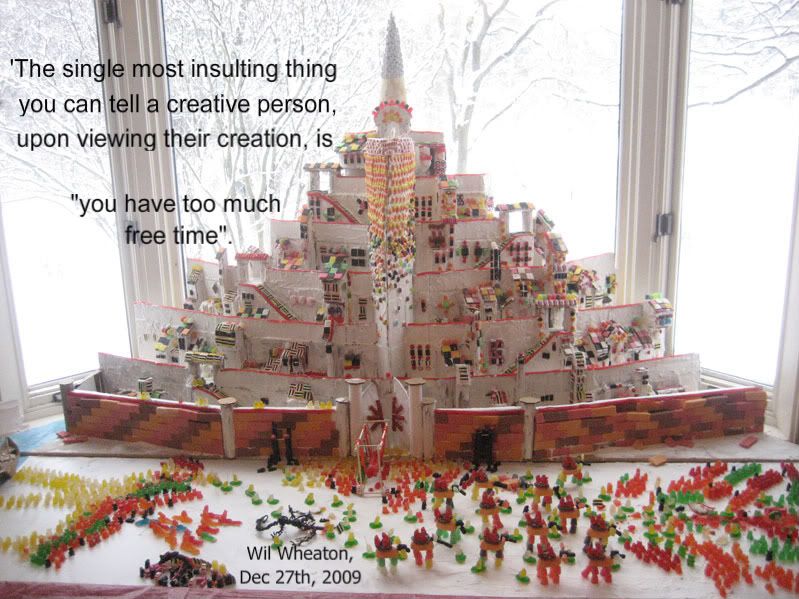


I shall be putting them up on this photobucket account, the Postcards every Wednesday (roughly) and the daily photos whenever I can be bothered to make an update, probably every couple of days and at least every week with any luck.

Monday, 28 December 2009

Merry... Saturnalia? (lessons from history 3, festive edition)

or the ‘birthday of the unconquered sun’, normally referred to as Sol Invicta. December has always been a month of celebration. With the sun getting lower and lower there has always been a tendency to try to make sure the sun does actually come back. Plus it’s cold, dark and food is short, so a celebration is quite nice to keep everyone’s spirits up. Celebrating the winter solstice has long been a feature of human society.

Christmas is no different. The date of Christmas is supposed to be the date of Jesus’ birth, but this is probably not the case. Festivals in late December had long been a feature of the Roman world; in fact there were at least two of them.

The first one was called Saturnalia. It took place in late December and saw the exchange of gifts and the relaxing of formalities. In fact it was tradition to reverse social roles; the wealthy were expected to pay the rent for those who couldn’t afford it. Master and slave exchanged clothes, family households threw dice to decide who would play the role of family monarch. Overall, a rather Christmassy affair.

Saturnalia was originally a festival to celebrate the end of the autumn planting season. It came later and later as the years went on and the scale of the festivities also increased. By the birth of Jesus it was a two day festival around mid-December. A hundred years later it lasted for a week. Changes to the Roman calendar placed the festival at 25th December, around the date of the winter solstice. From the third century AD there were public banquets in celebration of Saturnalia. The authorities tried in vain to restrict the festivities. By the end of the first century however they had embraced the festival and emperors started using it as a tool to improve their own popularity by putting on typically lavish celebrations at their own expense.

Even with the conversion of the Roman Empire to Christianity in the fourth century, Saturnalia continued to be celebrated. The Roman Empire did not turn Christian overnight. The majority of the empire remained Pagan for years after the official religion became Christian.

The second contender for the Roman forerunner for Christmas is called the festival of dies natalis solis invicti It was not actually a roman festival to start with, but originated in Syria as a celebration of the God Mithras. Typically of the Roman Empire, the cult was soon assimilated into the Roman Parthenon. Celebrations of Sol Invicti took place on the 25th of December, the day after the winter solstice on the Julian calendar. It was first introduced to Rome in the late third century and took over many of the features of Saturnalia. Sol Invicti is linked with the monotheistic cult of Mithras, which strongly resembled Christianity and indeed many of the non-biblical catholic rituals; celebrating a festival on 25th December being one of them, derive from this cult.

When the Roman Empire became Christian in the fourth century, the new Christian religion had to be made to fit with current religious practices. Christianity was made more acceptable by simply not changing much for most people. This cynical pragmatism does not however indicate a lack of belief, simply an acceptance of the difficulties of imposing such a radical change on people.

Fear not though, there is some Jewish basis for having Jesus birthday on 25th December. In Judaism the time of a prophet’s death is often associated with the time of their conception, so if Jesus was conceived in late March, he would be born in late December.

Why am I telling you this you ask? Because I can and because knowledge is always good to have. It’s Christmas, so my gift to you all is something to impress family and friends with next year; knowledge of the roman origins of Christmas. All that remains is for me to wish you all a very happy Sol Invicti and hope that Santa gave you lots of pressies. Maybe next year I’ll talk about why Santa Clause is part of the Christmas festivities. Meanwhile, goodbye the 00’s next time I write it will be 2010. Isn’t that exciting?

Tuesday, 22 December 2009

Dying Young

Again this week I am afraid that the news has let us down in that nothing of interest at all has happened. So I am continuing the project started here . Without further ado, my second challenge:

Dying Young. Write a fragment of a story about a character who is relatively young (under 40), who will die in a few years, but has no inkling of this. You, as author, do, though, and let that knowledge affect this brief story however it will affect the story. (500 words, again, a rough guide, this one is actually 544 words)

Richard strode into his office. He wore and Armani suit, a silk tie and the finest leather shoes. It was an ordinary day in the life of an extraordinary man.

Richard had grown up in Liverpool amid poverty and violence. His father beat him and his mother was unfaithful. He had gone to a shit school with shit teachers and shit pupils. According to the laws of nature Richard should have worked in a dead-end job all his life, married someone he didn’t love and had kids he didn’t want. But Richard did not believe in the laws of nature. He didn’t believe that man is a product of his environment, but that his environment is a product of man. He rejected the stereotype that all the shit pupils of his shit school with shit teachers had fallen unquestioningly inline with. You see Richard was clever. Despite the best efforts of his environment, Richard got good grades in school. His father had neither the money nor the will to send his genius son to university, so Richard set up his own business at the age of 18.

Ten years of brilliant entrepreneurship and cutthroat ruthlessness later, Richard was standing in his office at the top of a tower in Central London, a millionaire in his twenties and one of the most important businessmen in the country. His astronomic rise to wealth however had left the corpses of many businesses led by middle class, competent university graduates in his wake.

“Sir,” Richard’s secretary stood by the door.

“Yes Carol” he did not turn to talk to her.

“Your latest business acquisition is being blocked by the competition commission. They are afraid of you developing a monopoly.”

Richard sighed. “Do I look as if I care?” his voice retained some hints of his formerly strong scouse accent. “just bribe a few people at Whitehall and they’ll soon come round to my point of view.”

“They’re also afraid that your takeover will eliminate hundreds, if not thousands of jobs. They’re wondering whether you’ll be creating any new jobs to compensate.”

“Carol I am running a business not a fucking charity. If they’re good enough they can find a job elsewhere, if not then they don’t deserve it. I am taking over this business because I know I can turn a profit from it. I can do that because I can do things more efficiently than the moron who was running the company before. The current structure of the company is so bogged down with bureaucracy and inefficiency that it’s a wonder anything every gets done. I can cut costs by cutting out all the dead wood that exists. In doing that I am bound to reduce the number of jobs and hence reduce the payroll, in turn making my profit margins higher. So if the pen pushing do-gooders and red tape enthusiasts in Whitehall think I am going to create pointless jobs to give some thick dick from Birmingham a job when I don’t need him for anything, they have another thing coming.

“Now go get me my coffee.” Carol left silently.

Richard sat down on his leather backed chair and sighed. Meanwhile the cancer ate away at him, slowly bringing his cruel life to an end.

Monday, 14 December 2009

white lies

Earlier this week former Prime Minister Tony Blair admitted that he would have gone to war with Iraq even if he had known that there were no WMDs in the country. He said that he would have used different arguments to justify the war. Essentially Blair has admitted that he lied to the country in order to commit us to a war which he knew would be difficult to sell to a public who rightfully saw no direct link between Iraq and the 9/11 attacks, or indeed any actual threat from the regime.

In the build up to war, the main thrust of the arguments centred around the fear that Iraq was hiding Weapons of Mass Destruction which could be used against Britain at very short notice. In less than an hour, it was reported, Iraq could fire dangerous weapons at us. This claim was questioned at the time and now it has been shown to be little more than a convenient argument. It probably wasn’t true and even if it was, it was only a shallow justification, not the actual motivation for the war.

Blair said that the real reason for going to war was the removal of Sadam, who had, after all, used chemical weapons against his own people. I do not debate that Sadam’s regime was evil and deserved to be removed, but I was not aware that Britain still claimed to be a world police force. I thought our national ego had significantly deflated after we lost the empire. Apparently Blair still harboured delusions of grandeur about Britain’s place in the world. Delusions he clearly did not feel were shared given his refusal to be honest about his reasoning for the war.

If we were to follow Blair’s rather arrogant train of thought all the way to the end of the line, we would end up trying to justify war with just about half of the world. If Blair sees it as Britain’s job to remove oppressive dictatorships, we should probably think about attacking most of Africa. Robert Mugabe is just one of many dictators who are just as bad as Sadam was in 2003. How about the rest of the Middle East? Surely Iran and Saudi Arabia are just as bad as Iraq was. Perhaps the reason Blair didn’t go to war with either of those countries is that they might actually have WMDs.

Like a playground bully, Blair went to war with a country he knew he could defeat. He could make himself and his country (but mostly himself) look like a great, moral man who it willing to go to war in order to protect people and spread liberal western democracy. Whether the people wanted his protection or his democracy is up for debate.

We may of course be missing an elephant in the room here. Blair did not go to war with Iraq on his own; like a loyal dog, Blair followed Bush. I don’t know what Bush’s justification was, I’m not even sure Bush knows what his justification was. Either way Blair was not so much the playground bully as the sidekick who tries to look big and impressive by following the bully wherever he goes.

Whatever his motivation, what’s clear is this; Tony Blair lied to the public and the House of Commons in order to justify a war which would otherwise have been unjustifiable. It is highly doubtful that Blair would have been able to get the support of the Commons or the public without the scaremongering that accompanied the false assertions about WMDs. Blair’s lie has cost lives of hundreds of British soldiers, fighting for a cause which was unjust and unnecessary.

Blair’s confidence that the war was just and the removal of Sadam was for the good seems rather shallow. If he actually believed that his cause was just, why did he not use that to argue for the war, rather than hide behind the probably false assertion that Iraq had WMDs? One has to question whether or not this new claim is little more than another convenient argument to make Blair look like a moral man when actually he went to war for far more selfish reasons.

Sunday, 6 December 2009

Lessons from History 2

Earlier this week Barak Obama pledged a further 30,000 troops to the war in Afghanistan in the hope that this troop surge will have the same effect as a similar surge in Iraq last year. It won’t. The war in Afghanistan is not one that can be won by sheer force on numbers. Indeed I would debate whether the war in Afghanistan is winnable at all. Certainly when one looks to the history of Afghanistan, we see that every invader has come upon the same problems as the British and American troops are coming upon today.

We can go even as far back as Alexander the Great and still see similarities. Alexander invaded Afghanistan in 330 BC and, despite early success, was soon dragged into a long and arduous guerrilla war which claimed the lives of hundreds if not thousands of troops and led to Alexander himself receiving a near fatal wound. While Alexander’s powerful and experienced army was able to sweep away any opposition that stood in its way, it had a much harder time dealing with the guerrilla, hit-and-run tactics of the Afghan tribesmen. As soon as Alexander swept through Afghanistan, founding cities and replacing the Persian Satrap with his own governor, the locals fled to the hills. Strategic victories and the besieging of major cities was not enough to conquer Afghanistan for Alexander, nor was it enough for the British invaders over two millennia later.

In 1839 Afghanistan provided a neutral buffer between British controlled India and Russia, which was hostile to British control of the subcontinent. So when a Russian diplomat arrived in Kabul, fears of Afghanistan becoming a Russian Satellite state ignited. In a typical aggressive, imperialist move, an invasion of Afghanistan was ordered. British troops took Kabul in less that 8 months and installed a puppet ruler on the throne. Despite this they spent the next three years trying and failing to subdue the Afghan countryside before withdrawing, having achieved little apart from the loss of thousands of men. The British faced the same problems as Alexander; the Afghan tribesmen retreated to the hills and disappeared into countryside that they knew far better than the British. The invaders ended up trying and failing to fight an invisible enemy who could disappear as quickly as they could emerge unsuspected from the hills and wreak havoc on the British troops. This time however they were not only fuelled by a general distain for the invader, but a fierce nationalism fuelled by religious devotion, a devotion that would only become more prevalent in later invasions.

Little had changed in 1878, when Britain invaded again for similar motives. Again quick gains were made, with Jalalabad and Kandahar being subdued within a couple of months. A treaty was drawn up and it seems that the objectives have been achieved quickly and easily. However when the British ambassador was murdered, the war began again. A long guerrilla war was only adverted by installing a governor who was favoured by the tribesmen. For a change the second Afghan war was fought like a conventional war, with armies fighting each other, rather than elusive guerrillas. It is not surprising then that the British won. The aims of the war were not to conquer Afghanistan, but to achieve a limited set of objectives which would result in Afghanistan falling under the Empire’s sphere of interest, but not actually being ruled directly by Britain. Britain did not try to subdue the Afghan countryside because it recognised that it could not, instead it was content to install a friendly ruler and leave him to manage the Afghan tribesmen.

More recently, in 1979, the Soviets attempted an invasion of Afghanistan. It has been called ‘Russia’s Vietnam’. Russian troops very quickly took Kabul, but were drawn into a long guerrilla war against the Mujahideen, an extreme Muslim group who took to the hills and violently opposed the Russian invaders. Fuelled by religious fanaticism, the Mujahideen out fought the second most powerful military in the world. After using extreme measures to dispose of the Guerrillas, such as Napalm and poison gas, the Russians withdrew from Afghanistan, her face red with embarrassment at the failed war against such a minor power, despite the support of the ruling party.

History tells us then that wars in Afghanistan almost inevitably descent into vicious insurgency. The mountainous landscape of Afghanistan endears itself to hit and run tactics from locals who know the area far better than any invader could hope to. These tribesmen come not from major cities, but small towns and villages, scattered around the country and almost impossible to subdue. Strategic victories are a myth. Taking cities and establishing control over the political centres is pointless, opposition comes not from the ruling classes, but the fiercely independent tribesmen. Extremist Islam only serves to extenuate this problem; Islamic hatred towards western Christianity fuels the tribal hatred of invaders. In short an invasion of Afghanistan is doomed to failure.

Obama’s decision to pour more troops into Afghanistan then, when set against the context of the violent history of the country, is absurd. More troops on the ground are not going to be any better adept at flushing out the insurgents as the troops currently in the country. No amount of troops will ever be able to subdue the country because whenever an area is cleared to the Taliban, they wait until the troops have left and return from their hiding places. The tribesmen live in the villages, so all then need to do in order to melt away is to return to their homes. They then become no different from other civilians.

When set in its historical context, the invasion of Afghanistan was never going to be anything but a futile waste of life and resources. The war is unwinnable because Afghanistan is not like any normal theatre of war. Unless the tribesmen are in support of the invader, the invasion is bound to become a guerrilla war, which the invader will never win. Further proof that we do not learn the lessons of history.

Sunday, 29 November 2009

The Coma

As you may have noticed the news is pretty damn boring this week, so rather than my usual rant about something regarding current affair, I thought I’d try something a little different.

I have on occasion posted some creative writing of mine to this blog. I’ve always really enjoyed writing, but I’ve not really had the time to pursue my interests further. In light of that I decided that it would be fun and interesting to write some short stories and post them here. My problem in this regard is that I tend to set my sights too high, I want to write long books with detailed and complicated plots. I want to create original and complex characters. I want to do things that I can’t really do in the time I have available to me with my current busy life. I need to limit the scope of my writing in order to get any real satisfaction out of it, rather than having dozens of unfinished projects and interesting ideas that never get to become more than ideas. So I have decided to try to do a series of writing exercises from the internet designed to improve your writing skills and pose a challenge that I should be able to finish, rather then leave as a loose end.

With this in mind, my first challenge:

The Coma: Write from the point of view of a person in a coma. This is a permanent condition; the patient will not come out of the coma but still understands the outer world. The catch: voices of loved ones are familiar, even intimately familiar, but the comatose person cannot attach names to the voices. The coma patient has lost this capacity. (500 words – I’m taking this is a rough guide, not a strict limit, in fact the story below is 521 words long)

“Will he ever wake up doctor?” It was a man’s voice, confident, yet betraying hints of weariness. I recognised the voice, but I did not know where from.

“I sincerely doubt it.” I assumed that this voice was the doctor. It sounded youthful, yet irritatingly formal. Although the only sense left to me was my hearing, I could tell that the room was crackling with tension. “I’m sorry.” His tone was professional; he could think if nothing else to say.

There was a pause. I thought I heard the sound of weeping and gentle comforting, but it was too quite for me to pick up clearly. The whirr of the medical equipment dominated my hearing, making it hard to tell what else was going on.

“How long, doctor,” the first man spoke again. The familiarity of his voice nagged at me. “Until…” he could not get the words out. “Until he passes away?”

“His position is stable.” Again the tone was overly formal, unsympathetic. I wondered how long ago the doctor had been a mere student in medical school. “There is no reason to say that his life may go on… indefinitely.”

“So he could remain like this forever?” there was an incredulousness in his voice. I wondered exactly who this man was, and why I could remember his voice.

“As long as we continue to sustain him, in theory, yes.”

“And if we don’t ‘continue to sustain him’?”

“Then he will die.”

“So he is to spend the rest of his life attached to a machine, with tubes stuck down his throat to feed him?” he was getting agitated. “You see, Penelope, what kind of existence is that?” I decided that Penelope was the person who I thought I heard crying before.

“John, he’s your brother! How can you talk like that?” The new voice was obviously Penelope’s. She sounded distraught, her voice close to breaking. She had been crying.

“I’m just saying that it’s not much of an existence. That body, that empty, functionless shell is not the man you once loved.” His words made me angry; the realisation that I could do nothing about it only fuelled my rage.

Clearly his words had had the same effect on Penelope. “I can’t believe you could say that! How do you know that he’s not still alive in there? How do you know he can’t hear us?” her voice was tight with barely disguised tears.

“Doctor, can he hear us?” I willed desperately to say something, to do something to indicate that I could here them. My comatose body could do nothing but listen, powerless to contribute.

“As far as we are aware his mind has all but closed down completely, I doubt if he can even think, let alone hear anything.” I wanted to scream.

“You see Penelope; he’s nothing but a body. He’s an empty shell, a body, nothing more. Not the man you married anymore.”

I heard a door slam.

“I think we should consider turning off the life support machines. There’s no sense prolonging a life so devoid of meaning.” I screamed. And no one heard.

Sunday, 22 November 2009

Desert Bus, for the Children

I think I have mentioned, if only in passing, Loading Ready Run (LRR), a sketch comedy troupe from Victoria in Canada. They produce really excellent comedy which you should all go watch here. More importantly however this week they are doing one an incredibly charity event in the name of Child’s Play.

Child’s play is a charity set up by Gabe and Tycho of the webcomic Penny Arcade. It works across the globe, although mostly in the USA, to improve the lives of sick and injured children in hospitals by providing them with Toy and games. Not quite working to alleviate world poverty, but valuable work nonetheless. It’s been going since 2003 and has raised millions of dollars in that time thanks to the philanthropy of the gaming industry. In the last two years LRR have contributed over $80 000.

They have achieved this mostly through an event called Desert Bus for Hope (DBfH, sorry for all the acronyms and hyperlinks), which is happening for the third time in the coming days. DBfH is a gaming marathon whereby four members of the crew constantly play ostensibly the most boring video game every created, Desert Bus. Desert Bus simulates driving in a bus from Tuscan to Vagas and back, an 8 hour round trip along a perfectly straight road. The only thing that keeps the player involved is that the bus steers slightly to the right, forcing the player to continually correct it. The more the public donates to Child’s Play, the longer the crew plays this game. The donation needed per hour goes up each time, so as the marathon gets longer the amount needed to increase the length of the marathon increases. That being said last year they went for over five days and raised over $70 000.

Yesterday, at 6:20 PM (PST), or 2:20 AM (GMT) Desert Bus for Hope 3 started. Having been going for 18 hours already, they have so far raised almost $18 000 dollars. The aim of course is to beat last year’s total by a considerable amount. This is not possible however without the donations of ordinary people worldwide. As in previous years the even is being streamed live on Ustream here. You should all go and check it out, watch the stream for while, donate some money if you have any to spare and generally support the event. They auction off things and give challenges, so it’s well worth checking it out.

Again, please do support the event in any way you can, it’s a great way of forcing a group of Canadians to do your bidding in the name of charity if nothing else.